Claude Superpack
- 33 specialized skills
- 87% lower token usage per review
- Zero external dependencies
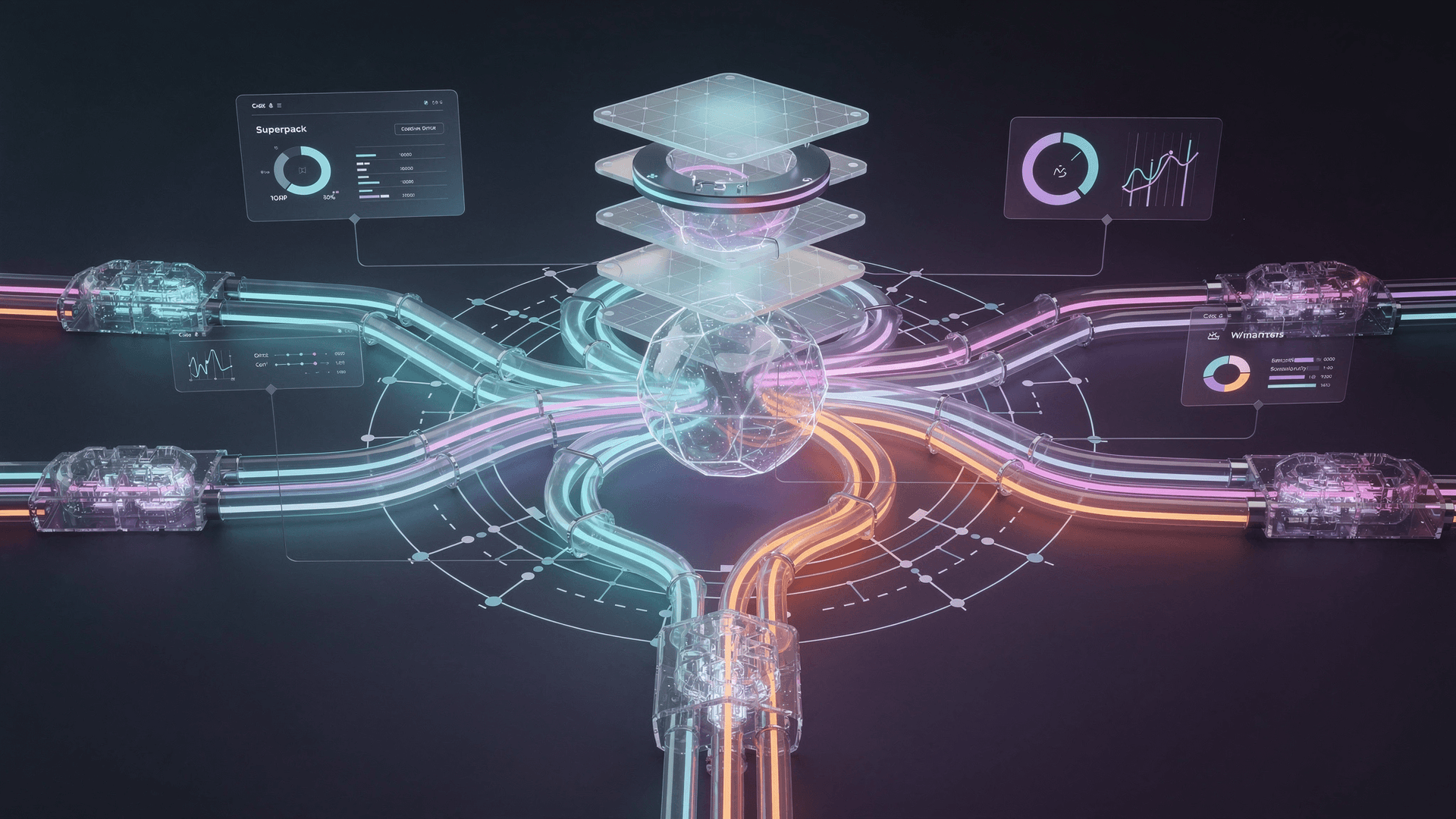
Problem: Claude Code starts from scratch every time, losing context, reinventing wheels, and requiring constant hand-holding for complex tasks.
Solution: Built a 33-skill agentic orchestration system for Claude Code featuring persistent memory, blast-radius-aware codebase graphs, parallel worker coordination, and self-improving behavior.
Impact: Transformed a single-shot assistant into an autonomous, stateful agent that safely orchestrates complex tasks with zero external dependencies.
Overview
Claude Superpack transforms Claude Code from a single-shot assistant into a persistent, self-improving agent that remembers across sessions, maps your codebase structurally, scans for security issues, and orchestrates complex tasks across parallel workers.
Before / after
Task Execution
Before: Manual step-by-step sequential guidance
After: Autonomous multi-agent parallel orchestration
Context Awareness
Before: Started entirely fresh every session
After: Persistent memory and preferences across sessions
Stack
Decisions
Key trade-offs and design calls that shaped the final delivery.
Zero external dependencies
Context: Adding databases like SQLite or ChromaDB creates friction for local agent workflows
Decision: Used pure markdown for memory and JSON for graphs, enabling instant adoption without complex installation requirements
Token compaction protocol
Context: Large codebases quickly exhaust the LLM context budget during complex tasks
Decision: Implemented running estimates with an active compaction protocol where structured summaries replace raw data after each phase
Architecture
The primary system boundaries, runtime pieces, and how the project was structured in production.
Task Decomposer & Workers
Agentic Orchestration
Routes requests intelligently. Complex tasks are decomposed into DAGs and executed by parallel agents orchestrated through safe-summon.
Markdown Storage
Persistent Memory
Zero-dependency memory system using local Markdown files for recent sessions, long-term patterns, and project context.
Graph Builder
Knowledge Graph
Structural codebase mapping using Glob/Grep/Read. Allows blast-radius-aware code reviews saving up to 87% token usage.
Mermaid source. Paste into mermaid.live to visualize the diagram.
flowchart TD
  U[User Request] --> R[auto-router]
  R --> |Direct| D[direct answer]
  R --> |Orchestrate| O[parallel-orchestrator]
  O --> W1[Worker 1]
  O --> W2[Worker 2]
  W1 --> M[merge-coordinator]
  W2 --> M
  M --> P[post-review]
Pipeline
How changes moved from development through validation and deployment.
Analyze
auto-routerClassifies complexity and routes to the appropriate execution tier
Map
graph-builderConstructs structural map of codebase lazily over time
Execute
parallel-orchestratorSpawns isolated workers for decoupled parallel tasks
Verify
security-scannerChecks for OWASP top 10 patterns and hardcoded secrets before commit
Incidents
Operational failures, rehearsals, or recovery moments that changed how the system was run.
Context budget exhaustion on large codebase reviews
P2Resolution: Implemented graph-aware smart discovery and blast-radius filtering, dropping token usage by ~87%
Lesson: Blindly sending raw code to LLMs scales poorly—pre-process and map dependencies to only pass relevant file slices
Agents getting stuck in conflicting execution loops
P3Resolution: Built a conflict-detector to map write surfaces beforehand and orchestrate workers sequentially if overlap is detected
Lesson: Parallel AI workers need strict concurrency boundries and conflict detection to avoid un-mergeable chaos